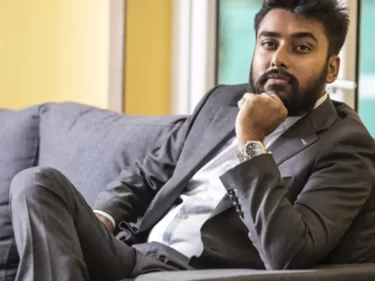
Sandeep Nailwal Net Worth 2026: India’s Crypto Billionaire & Polygon Founder
 by Ashish Arora
Who is Sandeep Nailwal?
In India’s rapidly growing cryptocurrency ecosystem, no name carries more weight than Sandeep Nailwal.
The co-founder of Polygon — one of the world’s most important blockchain scaling platforms — and the first CEO of the Polygon Foundation, Nailwal has built something extraordinary: a world-class blockchain infrastructure company, starting from humble beginnings in a Delhi slum, without even cracking IIT.
His story is one of the most inspiring in all of Indian technology — a farmer’s son from a remote Himalayan village who grew up without electricity, moved to Delhi, failed the IIT entrance exam, and went on to co-found a blockchain network that processes hundreds of millions of transactions, partners with JPMorgan, Stripe, and Disney, and is positioned as a foundational layer of the next internet.
So what is Sandeep Nailwal’s net worth in 2026? How did he build Polygon from a small Mumbai office into a global infrastructure giant? And what is he doing now?
Sandeep Nailwal Net Worth 2026
Sandeep Nailwal’s estimated net worth in 2026 is between $400 million and $1.8 billion.
The wide range reflects the volatility of crypto markets and the difficulty of valuing his POL (formerly MATIC) token holdings, which fluctuate dramatically with market conditions.
Most balanced 2026 analyses place his net worth in the $400 million to $800 million range — though more optimistic estimates tied to Polygon’s peak valuations go as high as $1.8 billion.
| Source | Estimate | Year |
|---|---|---|
| Conservative (market-adjusted) | ~$400–800 million | 2026 |
| Optimistic (peak valuation) | ~$1–1.8 billion | 2026 |
| Earlier estimates | ~$1.2 billion | 2023 |
He is widely recognized as one of India’s first crypto billionaires — alongside his Polygon co-founders Jaynti Kanani and Anurag Arjun.
Net Worth Timeline
| Year | Estimated Net Worth | Key Event |
|---|---|---|
| 2017 | ~$1 million | Matic Network founded |
| 2021 | ~$500 million | Polygon rebranding + bull market |
| 2021 (Peak) | ~$1.2 billion | MATIC all-time high |
| 2022 | ~$200–300 million | Crypto crash |
| 2024 | ~$600 million | Market recovery |
| 2025 | ~$1 billion | POL revival + CEO appointment |
| 2026 | ~$400M–$1.8B | Current estimate |
Early Life — From Himalayan Village to Blockchain Billionaire
Sandeep Nailwal was born on July 12, 1987, in Ramnagar, Nainital — a small town in the foothills of the Himalayas in Uttarakhand, India. His family later moved to Delhi in search of better opportunities.
His background could not have been more humble. He grew up in a Delhi slum, raised by a father who struggled with addiction. The family had limited resources, and opportunities were scarce.
But Nailwal was a determined student. He set his sights on the IIT (Indian Institutes of Technology) — India’s most prestigious engineering institutions and arguably the most competitive entrance exams in the world.
He did not crack IIT.
Rather than give up, Nailwal pivoted. He pursued his education at the National Institute of Industrial Engineering (NITIE) in Mumbai — one of India’s top management institutes — where he earned a Master’s degree in Business Administration with specializations in Computer Systems Technology, Finance, and Supply Chain Management.
This combination of technical and business education would prove uniquely valuable in the world of blockchain — where both deep technical knowledge and business strategy are essential.
Early Career — From Software Engineer to Entrepreneur
After completing his education, Nailwal began his professional career as a Software Engineer at Computer Sciences Corporation — gaining foundational technical experience.
He then joined Deloitte — one of the world’s largest professional services firms — where he worked as a consultant handling management consulting, program management, and other complex engagements.
These experiences gave Nailwal a rare combination of technical depth and business sophistication — the exact profile needed to build and scale a blockchain infrastructure company.
His entrepreneurial instincts emerged early. Before Polygon, he co-founded ScopeWeaver — a blockchain solutions company that gave him hands-on experience building decentralized applications.
It was through this work that Nailwal connected with Jaynti Kanani and Anurag Arjun — and together, in 2017, they founded what would become Polygon.
Founding Matic Network — The Problem They Solved
In 2017, Nailwal, Kanani, and Arjun founded Matic Network in a small Mumbai office with a clear mission: solve Ethereum’s scalability problem.
The problem: Ethereum — the world’s second-largest blockchain — was slow, expensive, and congested. As DeFi and NFTs grew, transaction fees (known as “gas fees”) soared to hundreds of dollars per transaction. The network could only process about 15 transactions per second — nowhere near enough for global adoption.
The solution: Build a Layer 2 scaling solution — a separate network that runs on top of Ethereum, processing transactions faster and cheaper, while using Ethereum’s security as its foundation.
Matic Network used a technology called Plasma (later evolving to use Proof of Stake) to batch transactions off the main Ethereum chain — dramatically reducing fees and increasing speed.
The project was accepted into the prestigious Binance Launchpad in 2019 — one of the first projects to raise funds through Binance’s token launch platform — giving it immediate credibility and global exposure.
From Matic to Polygon — The Rebrand That Changed Everything
In February 2021, Matic Network announced a dramatic rebrand and expansion — becoming Polygon.
The rebrand was not just cosmetic. Polygon transformed from a single Layer 2 solution into an entire ecosystem of scaling solutions — offering multiple ways to build and scale Ethereum-compatible applications:
- Polygon PoS — the original proof-of-stake sidechain
- Polygon zkEVM — a zero-knowledge proof-based Ethereum virtual machine
- Polygon CDK — a toolkit for building custom ZK-powered blockchain networks
- Polygon Miden — an advanced ZK rollup
This multi-solution approach positioned Polygon not just as a single product but as the infrastructure layer for the entire next generation of blockchain applications.
The rebrand coincided perfectly with the 2021 DeFi and NFT boom — and Polygon’s ecosystem exploded. Major platforms including Aave, Curve, OpenSea, Decentraland, and hundreds of others integrated Polygon, driving massive user adoption.
MATIC token — Polygon’s native cryptocurrency — surged from under $0.02 in early 2020 to an all-time high of approximately $2.92 in December 2021 — a rise of over 14,000%.
Polygon’s Major Partnerships — JPMorgan, Stripe, Disney and More
One of Polygon’s most remarkable achievements under Nailwal’s leadership has been securing partnerships with some of the world’s most prestigious institutions:
| Partner | Integration | Year |
|---|---|---|
| JPMorgan | Polygon PoS for institutional DeFi | 2022 |
| Stripe | Polygon payments infrastructure | 2023 |
| Disney | Disney Accelerator program participant | 2022 |
| Meta (Facebook) | NFT integration on Instagram | 2022 |
| Starbucks | Starbucks Odyssey NFT loyalty program | 2022 |
| Nike | .SWOOSH NFT platform | 2023 |
| Draft Kings | NFT marketplace | 2021 |
These partnerships with Fortune 500 companies and global brands legitimized Polygon as enterprise-grade blockchain infrastructure — far beyond what most crypto projects had achieved.
The POL Token — Polygon’s Evolution in 2026
In 2024, Polygon rebranded its native token from MATIC to POL — reflecting the network’s evolution into a broader ecosystem of ZK-powered chains.
POL is designed to be used across all Polygon chains — not just the original PoS network — creating a more versatile and powerful token economy.
Key 2026 developments for Polygon:
- Record stablecoin transactions — Polygon hit an all-time high of 493 million stablecoin transactions in early 2026
- Gigagas roadmap — targeting transaction fees below $0.001
- RISE incentive token — new ecosystem incentive mechanism
- Acquisitions — Coinme (cash-to-crypto) and Sequence (wallet infrastructure) acquired for the Open Money Stack initiative
Sandeep Nailwal Becomes CEO of Polygon Foundation
In June 2025, Nailwal was appointed as the first CEO of the Polygon Foundation — a significant milestone that formalized his leadership role in shaping Polygon’s long-term direction.
This appointment came at a critical time — as Polygon was navigating the transition to ZK technology and competing with other Layer 2 solutions like Arbitrum, Optimism, and zkSync.
As CEO, Nailwal has been focused on:
- Driving POL token revival in 2026
- Building out Polygon’s ZK technology stack
- Expanding into Real-World Assets (RWA) and stablecoin payments
- Positioning Polygon as the open infrastructure layer for the next internet
COVID-19 Crypto Relief Fund — India’s Greatest Crypto Philanthropic Effort
One of the most remarkable chapters in Nailwal’s story is his response to India’s devastating second COVID-19 wave in April 2021.
As India’s healthcare system collapsed under the weight of the Delta variant — with oxygen shortages, hospital bed scarcity, and thousands dying daily — Nailwal launched the Crypto Relief Fund on April 24, 2021.
The response from the global crypto community was extraordinary:
- Vitalik Buterin donated 50 trillion SHIB tokens (worth approximately $1 billion at peak) to the fund
- Dozens of other crypto projects and individuals contributed
- The fund ultimately received approximately $6 million in crypto donations across ten different cryptocurrencies
- The funds were used to purchase oxygen concentrators, PPE, and medical supplies for Indian hospitals
The initiative demonstrated that the crypto community could mobilize for genuine humanitarian purposes — and positioned Nailwal as not just a business leader but a compassionate community figure.
Symbolic Capital — Venture Capital for Web3
Beyond Polygon, Nailwal co-founded Symbolic Capital — a venture capital firm focused on investing in early-stage Web3 projects.
Symbolic Capital has made over 100 investments in promising blockchain and Web3 startups, with recent focus areas including:
- AI x Crypto intersections
- Zero-Knowledge (ZK) technology
- Decentralized Identity (DID)
- Web3 infrastructure
In 2026, Nailwal co-founded Sentient — a decentralized AI research initiative that raised $85 million (led by Founders Fund, Peter Thiel’s firm) to build open-source, verifiable AI models resistant to centralized control.
This AI initiative reflects Nailwal’s belief that the intersection of decentralized networks and artificial intelligence is one of the most important technological frontiers of the coming decade.
Personal Life
Sandeep Nailwal is married to Harshita Singh. He is currently based in Dubai — one of the world’s most crypto-friendly jurisdictions, with no personal income tax and a rapidly growing Web3 ecosystem.
He is known within the Indian crypto community as:
- Deeply passionate about blockchain’s potential to transform Indian society
- Vocal about the importance of Web3 education and adoption in India
- Committed to philanthropy — particularly around education and healthcare
- A role model for young Indians aspiring to careers in blockchain technology
He founded the Nailwal Fellowship — an initiative to support promising blockchain developers and entrepreneurs from India.
Sandeep Nailwal vs Other Indian Crypto Entrepreneurs
| Person | Company | Estimated Net Worth 2026 |
|---|---|---|
| Sandeep Nailwal | Polygon | ~$400M–$1.8B |
| Nischal Shetty | WazirX | ~$50–100M |
| Sumit Gupta | CoinDCX | ~$50–100M |
| Ashish Singhal | CoinSwitch | ~$50–80M |
Nailwal’s wealth dwarfs other Indian crypto entrepreneurs — primarily because Polygon operates at global scale and the POL token has global market value.
Sandeep Nailwal vs Global Crypto Figures
| Person | Company | Net Worth 2026 |
|---|---|---|
| CZ | Binance | $50–110 billion |
| Vitalik Buterin | Ethereum | ~$467M–750M |
| Sandeep Nailwal | Polygon | ~$400M–$1.8B |
| Michael Saylor | Strategy | ~$4.7B |
| Brian Armstrong | Coinbase | ~$8.9B |
Key Lessons from Sandeep Nailwal’s Journey
1. IIT nahi hua — duniya nahi ruki Nailwal’s failure to crack IIT — India’s most prestigious exam — did not define his future. His story is a powerful reminder that the path to success is not linear.
2. Build solutions, not just products Rather than building a new blockchain from scratch (and competing with Ethereum), Nailwal and his team built on top of Ethereum — solving its biggest problem rather than trying to replace it.
3. Think global, act local Polygon is a global infrastructure platform — but Nailwal never forgot his Indian roots. The COVID Relief Fund and the Nailwal Fellowship reflect a commitment to giving back to the community that shaped him.
4. Conviction through volatility Nailwal has held his vision for Polygon through multiple market crashes — from MATIC falling 90%+ in 2022 to the POL revival of 2025-2026. Long-term conviction through short-term volatility is the defining trait of the most successful crypto builders.
FAQs — Sandeep Nailwal Net Worth 2026
What is Sandeep Nailwal’s net worth in 2026?
Sandeep Nailwal’s estimated net worth in 2026 is between $400 million and $1.8 billion, with most balanced estimates placing it in the $400–$800 million range.
Who is Sandeep Nailwal?
Nailwal is an Indian entrepreneur and the co-founder of Polygon (formerly Matic Network) — one of the world’s most important Ethereum scaling platforms. Since June 2025, he serves as the first CEO of the Polygon Foundation.
Is Sandeep Nailwal India’s first crypto billionaire?
Yes — along with his Polygon co-founders Jaynti Kanani and Anurag Arjun, Nailwal is recognized as one of India’s first crypto billionaires.
What is Polygon (formerly Matic)?
Polygon is a Layer 2 scaling solution for Ethereum that processes transactions faster and cheaper than the main Ethereum chain. It has evolved into a full ecosystem of ZK-powered blockchain solutions.
What did Sandeep Nailwal do during COVID-19?
In April 2021, Nailwal launched the Crypto Relief Fund — which received approximately $6 million in crypto donations (including $1 billion in SHIB from Vitalik Buterin) to purchase medical supplies for India during the devastating second COVID wave.
Where is Sandeep Nailwal based?
Nailwal is currently based in Dubai, UAE.
What is Symbolic Capital?
Symbolic Capital is a venture capital firm co-founded by Nailwal, focused on early-stage Web3 investments. It has made over 100 investments in blockchain and Web3 projects.
What is Sentient?
Sentient is a decentralized AI research initiative co-founded by Nailwal in 2026, which raised $85 million (led by Founders Fund) to build open-source, verifiable AI models.
Did Sandeep Nailwal crack IIT?
No. Nailwal failed to crack the IIT entrance exam — one of the world’s most competitive academic examinations. He instead studied at NITIE Mumbai.
Conclusion
Sandeep Nailwal’s story is one of the most powerful in the history of Indian technology.
From a farmer’s son born in a Himalayan village without electricity, raised in a Delhi slum, who failed IIT — to building one of the world’s most important blockchain platforms, becoming one of India’s first crypto billionaires, raising $85 million for decentralized AI, and being appointed the first CEO of the Polygon Foundation — his journey defies every expectation.
His estimated net worth of $400 million to $1.8 billion in 2026 represents wealth built through genuine technical innovation, long-term conviction, and a willingness to solve real problems at global scale.
As Polygon continues its evolution into a ZK-powered infrastructure layer for the next internet, and as Nailwal’s Sentient initiative pushes the frontier of decentralized AI, the most important chapters of Sandeep Nailwal’s story are very likely still ahead.
Disclaimer: Net worth estimates are based on publicly available information and should be treated as approximations. Cryptocurrency values are highly volatile. This article is for informational purposes only and does not constitute financial advice.